The Wingfields’ fire escape
The Glass MenagerieThe Wingfields’ fire escape is the apartment’s practical entrance and the play’s central image of departure: a narrow threshold between the family’s enclosed rooms and the alley beyond. It frames Tom’s life as both remembered and performed, linking his first appearance as a merchant sailor to his eventual descent from the apartment and the guilt that continues to follow him.
Setting and theatrical design
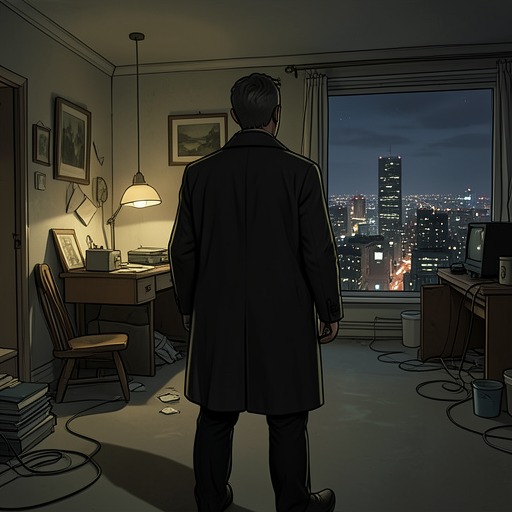
The Wingfield apartment occupies the rear of a vast, crowded tenement, facing an alley and entered from the fire escape. The visible structure consists of its landing and descending steps. In the opening stage picture, the audience first confronts the building’s dark rear wall, hemmed in by narrow alleys, tangled clotheslines, garbage cans, and neighboring fire escapes. The apartment interior is disclosed only after the wall gradually becomes transparent.
This architecture carries an explicit social meaning. The tenement is described as one of the cellular masses that grow in overcrowded urban centers, where lower-middle-class residents are pressed into a collective life marked by limited freedom and differentiation. The building’s fires are not literal: the fire escape’s name becomes an accidental poetic truth because the enormous structures burn with the slow fires of human desperation. The image makes the route out both ordinary and ominous, a necessary fixture attached to a world of confinement.
The setting is governed by memory rather than naturalistic continuity. Tom’s recollection omits or exaggerates details according to their emotional weight, leaving the apartment dim and poetic. The transparent exterior wall and gauze portieres let the audience look into the family’s rooms while also exposing the theatrical apparatus. During the opening dining-room scene the fourth wall rises out of sight; it remains absent until Tom’s final speech. The fire escape therefore belongs not only to the apartment but to the visible frame through which Tom’s recollection is staged.
Tom’s threshold and departures
Tom first appears dressed as a merchant sailor. He crosses to the fire escape, stops on it, lights a cigarette, and addresses the audience. The landing makes his position between household and outside world immediately visible. From there he explains that the play offers truth in the pleasant disguise of illusion and turns time back to the 1930s. The fire escape is thus present at the moment the remembered story declares its method: Tom stands at a physical threshold while opening a passage into the past.
The structure also marks the family’s conflict over Tom’s work and freedom. In an argument with Amanda, he rejects the warehouse and the prospect of spending fifty-five years there, describing the celotex interior and fluorescent tubes as intolerable. He says that for sixty-five dollars a month he gives up what he dreams of doing and being, and points to his father’s photograph when he insists that self-interest would have led him to disappear. After Amanda grabs his arm, he tells her not to grab him and says he is going to the movies. The exchange makes escape an immediate struggle over who controls his movement, not merely a distant fantasy.
Later, on the landing, Tom leans over the rail and tells Jim that he is planning a future without the warehouse, Mr. Mendoza, or even night school. The light from movie-house marquees and signs falls across his face, making him look like a voyager; he says he is tired of the movies. The fire escape is where his restlessness becomes a declared intention to change. Its height and outward orientation give a visual form to the future he imagines, even as the scenes around it show that intention has not yet become a completed departure.
The final descent and its return
In Tom’s closing account, the fire escape becomes the route he takes out of St. Louis. He says he was fired for writing a poem on a shoe-box lid, then descended its steps for the last time and followed his father’s footsteps, traveling widely in an effort to recover through movement what had been lost in space. The departure fulfills the promise attached to the structure, but it does not produce a clean break: the cities pass like brightly colored leaves torn from their branches, and something repeatedly catches Tom by surprise.
That pursuit takes the form of Laura’s memory. Tom imagines encountering colored glass and delicate bottles in a shop window, then turning to find his sister touching his shoulder. He admits that although he tried to leave her behind, he is more faithful than he intended to be. He responds by crossing the street, going into a movie house or a bar, buying a drink, or speaking to a stranger, trying to extinguish the candles she bends over. The fire escape can carry Tom away from the apartment, but it cannot sever the remembered bond that makes his freedom incomplete.
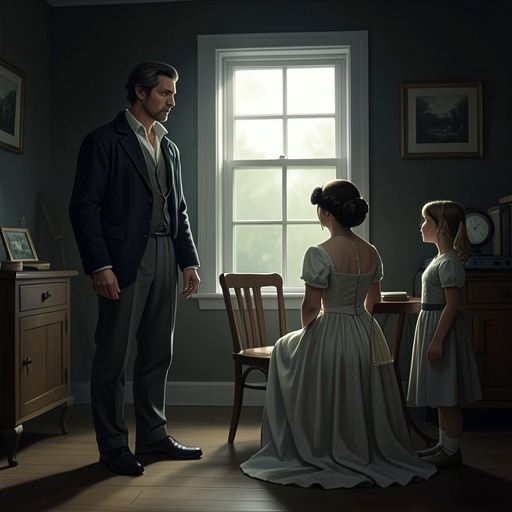
The ending returns to the apartment even as Tom speaks from beyond it. The audience sees Amanda comfort Laura through the transparent boundary: Laura is hunched on the sofa, her hair hiding her face, while Amanda’s gestures become slow and graceful. Amanda glances at the father’s picture before withdrawing; Laura lifts her head to smile at her mother, then bends over the candles and blows them out. Against this silent interior, Tom’s account of leaving turns the fire escape into a measure of distance rather than a guarantee of release. He can descend its steps only once in the literal sense; in memory, the passage remains open.
Narrative significance
The fire escape binds the play’s contrasting movements: entry into the Wingfield home, attempted flight from it, and a later return shaped by remembrance. Its steps promise a route from the confined apartment to the larger world, while the story’s frame shows that physical departure does not end Tom’s attachment to Laura. The same structure that gives his escape a concrete path also anchors the memory from which he speaks.
Its theatrical use reinforces that tension. The apartment wall becomes transparent to reveal the remembered interior, and the fourth wall remains raised until the final speech, when the play’s opening visual boundary is recalled at the point of reckoning. The fire escape is not simply scenery behind Tom’s movements: it gives those movements a visible threshold, while the memory-play form makes clear that leaving the room and leaving the past are different acts. The route outward remains attached to the family and to the image of Laura that Tom carries with him.